

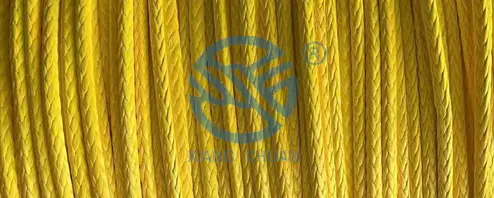
Safety assurance of marine ropes
Marine ropes are an indispensable and important equipment in ship operations and are widely used in key links such as mooring, towing, and anchoring. Their safety is directly related to the safety of ships, crew members, and cargo. To ensure the safety of marine ropes, comprehensive management is required from multiple aspects such as material selection, design and manufacturing, daily maintenance, and operating specifications. The following are the main measures to ensure the safety of marine ropes:
---
I. Material selection and quality control
1. High-strength materials
Marine ropes are usually made of natural fibers (such as hemp ropes, cotton ropes) or synthetic fibers (such as nylon, polyester, and polypropylene). Synthetic fibers have gradually become the mainstream choice due to their high strength, corrosion resistance, and wear resistance. The selection of materials should be based on specific uses and environmental conditions to ensure that the ropes can withstand the expected load.
2. Anti-ultraviolet and corrosion resistance
Marine ropes are exposed to the marine environment for a long time and are susceptible to erosion by ultraviolet rays, salt spray, moisture, etc. Therefore, the rope material should have good anti-ultraviolet and corrosion resistance to extend the service life and ensure safety.
3. Flame retardant performance
In emergency situations such as ship fires, the flame retardant performance of ropes is crucial. Selecting materials with flame retardant properties can effectively reduce the risk of fire.
4. Material certification
Rope materials should comply with the certification requirements of international standards (such as ISO, EN, etc.) and classification societies (such as DNV, ABS, CCS, etc.) to ensure their quality and reliability.
---
II. Design and manufacturing process
1. Structural design
The structural design of marine ropes directly affects their strength and durability. Common structures include three-strand ropes, eight-strand ropes, braided ropes, etc. When designing, the appropriate structure should be selected according to the specific purpose to ensure that the rope can evenly distribute the load when it is stressed and avoid local breakage.
2. Matching diameter and strength
The diameter of the rope should be reasonably designed according to its purpose and expected load. Too small a diameter may result in insufficient strength, while too large a diameter will increase weight and difficulty in operation. The breaking strength of the rope should be at least 5-6 times the working load to ensure a safety margin.
3. Manufacturing process
The process parameters should be strictly controlled during the manufacturing process to ensure the uniformity and consistency of the ropes. High-quality ropes should have no obvious defects, such as knots, broken wires, looseness, etc.
4. Quality inspection
Before leaving the factory, the ropes should undergo strict performance tests, including breaking strength test, elongation test, abrasion resistance test, etc., to ensure that they meet the design requirements and safety standards.
---
III. Daily maintenance and inspection
1. Regular inspection
Marine ropes should be regularly inspected for appearance, focusing on wear, broken wires, corrosion, deformation and other issues. For key parts (such as the contact points of mooring ropes), the inspection frequency should be increased.
2. Cleaning and maintenance
Ropes should be cleaned regularly to remove harmful substances such as salt and dirt. For synthetic fiber ropes, they can be rinsed with fresh water and dried; for natural fiber ropes, long-term soaking should be avoided.
3. Lubrication and protection
For certain types of ropes (such as wire ropes), lubricants should be applied regularly to reduce friction and wear. At the same time, protective sleeves or coatings can be used to enhance the wear and corrosion resistance of ropes.
4. Replacement standards
When the ropes are in the following situations, they should be replaced in time:
- Wear exceeds 10% of the diameter;
- The number of broken wires exceeds 5% of the total number of wires;
- Obvious deformation or hardening;
- Other defects that affect safety.
---
IV. Operation specifications and training
1. Correct use
The use of ropes should follow the operation specifications to avoid improper operations such as overloading, twisting, and knotting. For example, when mooring, ensure that the ropes are evenly stressed to avoid local overload.
2. Safe operation
When operating ropes, crew members should wear protective equipment (such as gloves, helmets) and keep a safe distance to prevent sudden breakage or rebound of ropes and cause injuries.
3. Emergency handling
Crew members should master the handling methods of emergency situations such as rope breakage and slippage to ensure that effective measures can be taken quickly to avoid the expansion of accidents.
4. Training and drills
Crews should receive regular training on rope operation and maintenance, and be familiar with the characteristics and usage of different types of ropes. At the same time, they should improve their ability to deal with emergencies through simulation drills.
---
V. Environment and use conditions
1. Adaptation to the environment
Marine ropes should be able to adapt to different marine environments, including extreme conditions such as high temperature, low temperature, high humidity, and strong winds. Choosing the right rope type and specification can significantly improve its safety and reliability.
2. Avoid harsh conditions
In bad weather or sea conditions, try to avoid using ropes for high-risk operations (such as towing and mooring). If necessary, auxiliary equipment (such as shock absorbers and sheaths) can be used to reduce the load and wear of ropes.
3. Storage and management
Ropes should be stored in a dry and ventilated environment, avoiding direct sunlight and chemical pollution. For ropes that have not been used for a long time, they should be checked and rearranged regularly to prevent aging or deformation.
---
VI. Technological innovation and future development
1. Application of new materials
With the development of materials science, new high-strength, lightweight and corrosion-resistant materials (such as aramid fiber and ultra-high molecular weight polyethylene) are gradually applied to marine cables, further improving their safety and performance.
2. Intelligent monitoring
By installing sensors and monitoring systems, the stress, wear and aging of cables can be monitored in real time, potential risks can be discovered in time, and the level of safety management can be improved.
3. Environmental protection and sustainability
In the future, the development of marine cables will pay more attention to environmental protection and sustainability, such as using recyclable materials or developing low-energy manufacturing processes to reduce the impact on the environment.
---
Conclusion
The safety of marine cables is a systematic project that requires comprehensive management from multiple aspects such as materials, design, manufacturing, maintenance, and operation. Through scientific selection, strict testing, standardized maintenance and operation, the incidence of cable accidents can be effectively reduced to ensure the safety of ships and crew. With the continuous advancement of technology, marine cables will develop in the direction of higher strength, more intelligence, and more environmental protection in the future, providing more reliable protection for navigation safety.
Alamat:
Jalan Chengnan No.8, taman industri chengnan, daerah Baoying, Jiangsu China
e-mel:
E-mail1:vanzer@xcrope.com Vanzer Tao
E-mail2:sales@xcrope.com Wang Peng
E-mail3:grace@xcrope.com Grace Li
E-mail4:info@xcrope.com David Cheng
Telefon syarikat:
+86-514-88253368
Jabatan jualan luar negara:
+86-514-88302931


Hak Cipta Oleh © Jiangsu Xiangchuan Rope Technology Co., Ltd. | Hak cipta terpelihara
Laman web ini menggunakan kuki untuk memastikan anda mendapat pengalaman terbaik di laman web kami.
 English
 Español
 Portugues
 Pусский
 Français
 Deutsch
 日本語
日本語 한국어
한국어 العربية
 Italiano
 Ελληνικά
 Polski
 Türk dili
 Indonesia
 Tiếng Việt
 বাংলা
বাংলা norsk
norsk Română
 Azərbaycan
 中文站
中文站
 +86-514-88253368



 telefon
Komen
(0)